

Restaurant Management Platform
A complete cloud platform for restaurants, cafés, franchises, and hospitality groups to manage reservations, ordering, kitchen operations, payments, delivery, inventory, and customer engagement from a single ecosystem.
- Estimated timeline
- Typically 12–18 weeks for a first production module
- Platforms
- Web · Mobile · Cloud
- Tech stack
- Next.js · Laravel · Stripe · OpenAI
The business scenario
Running a modern restaurant, café, or franchise group means running several businesses at once — a front of house that needs table and reservation control, a kitchen that needs real-time order visibility, a back office that needs inventory and supplier tracking, and a growing set of digital channels for QR ordering and delivery. Built for restaurants that need omnichannel ordering, AI-powered forecasting, and kitchen automation without stitching together a different tool for every one of those functions, this class of platform is what separates operations that scale smoothly from operations that hit a wall at the second or third location.
This Representative Solution demonstrates one possible architecture for solving that class of problem — a cloud restaurant management platform that connects table reservations, QR and mobile ordering, kitchen display systems, and POS integration behind a single operational system. Orders placed at the table, through a QR code, or via a delivery integration all flow into the same kitchen engine, inventory updates automatically as dishes are prepared, and an AI sales forecasting service predicts demand from real order history rather than static planning. Loyalty programs and customer profiles turn repeat visits into a connected relationship instead of an anonymous transaction, and every location in a multi-site group operates on the same system instead of its own disconnected setup. It is not a real client deployment. It is a reference implementation showing the engineering approach we would bring to a restaurant technology project like this.
The problems this platform responds to
The operational reality behind most enterprise software investments — not a single failure, but friction compounding across systems and teams.
How the platform addresses it
The platform centralizes restaurant operations behind a single cloud system — reservation and table management, QR and mobile ordering, a real-time kitchen display, and AI-assisted forecasting that turns order history into a demand signal.

Reservation & Table Management

QR Menu & Mobile Ordering
Kitchen Display System
POS Integration
Inventory & Supplier Management

Delivery Integration

Loyalty & Gift Cards
AI Sales Forecasting
What's included
The feature set that makes the solution overview concrete — each one a real, scoped piece of the platform, not a roadmap aspiration.
How the system is structured
A layered architecture routing every order through a dedicated order engine and kitchen engine, with AI forecasting and analytics as their own services rather than logic buried inside the application layer.
- 01
Customer App
The mobile and web entry point for customers — QR ordering, reservations, and loyalty.
WebMobileQR ordering - 02
API Gateway
A single entry point handling authentication, request routing, and rate limiting for every client.
AuthRate limitingRouting - 03
Restaurant Services
Core platform logic — reservations, table management, loyalty — as independently deployable services.
Node.jsLaravel - 04
Kitchen Engine
A dedicated service managing kitchen display tickets, station routing, and preparation status.
Real-time syncWebSockets - 05
Order Engine
The system of record for every order, regardless of channel — dine-in, QR, or delivery.
PostgreSQLRedis - 06
Payment Service
A dedicated service handling payment processing and reconciliation across every order channel.
StripePCI compliance - 07
Inventory Service
A dedicated service tracking stock consumption and triggering supplier orders from real usage.
PostgreSQLRedis - 08
AI Forecast Engine
A dedicated service turning order history into demand predictions for staffing and purchasing.
OpenAIForecasting models - 09
Analytics Dashboard
A metrics pipeline feeding sales, kitchen, and customer dashboards from the same underlying event data.
Metrics pipelineReporting
Built on a modern, production-grade stack
Every technology here is a deliberate choice, not a default.
How we approached the build
- Multi-location Architecture
The data model treats every location as a first-class entity from day one, not a single-site system stretched to fit a group.
- Offline-first POS
The point-of-sale client queues orders locally and syncs when connectivity returns, so a dropped connection never stops service.
- Real-time Kitchen Sync
Kitchen display updates propagate the moment an order changes state, not on a polling delay.
- Inventory Consistency
Every stock-affecting action goes through the inventory service as a single, atomic source of truth.
- Scalable Ordering
The order engine is designed to hold up as order volume and channel count grow, not just at a single location's scale.
- Secure Payments
Payment data is handled through Stripe's PCI-compliant infrastructure, never touching the platform's own database directly.
What this architecture is designed to achieve
This kind of platform is designed to change how a restaurant or hospitality group operates day to day — not to hit a specific number, but to remove the friction that makes kitchen coordination, inventory accuracy, and multi-location management harder to manage than they need to be.
Faster service, as reservations, ordering, and kitchen operations run through one coordinated system.
Lower food waste, with inventory tracked against real consumption instead of manual estimates.
Better customer experience, with QR ordering, loyalty, and reservations working together instead of separately.
Operational efficiency, as front-of-house, kitchen, and delivery staff work from the same live information.
Centralized management, replacing a different platform per function with one system across the group.
Scalable restaurant operations, since the platform's architecture holds up as the number of locations grows.
Frequently asked questions
More representative solutions
Other reference architectures from the same Representative Solutions collection.
Property Management Cloud
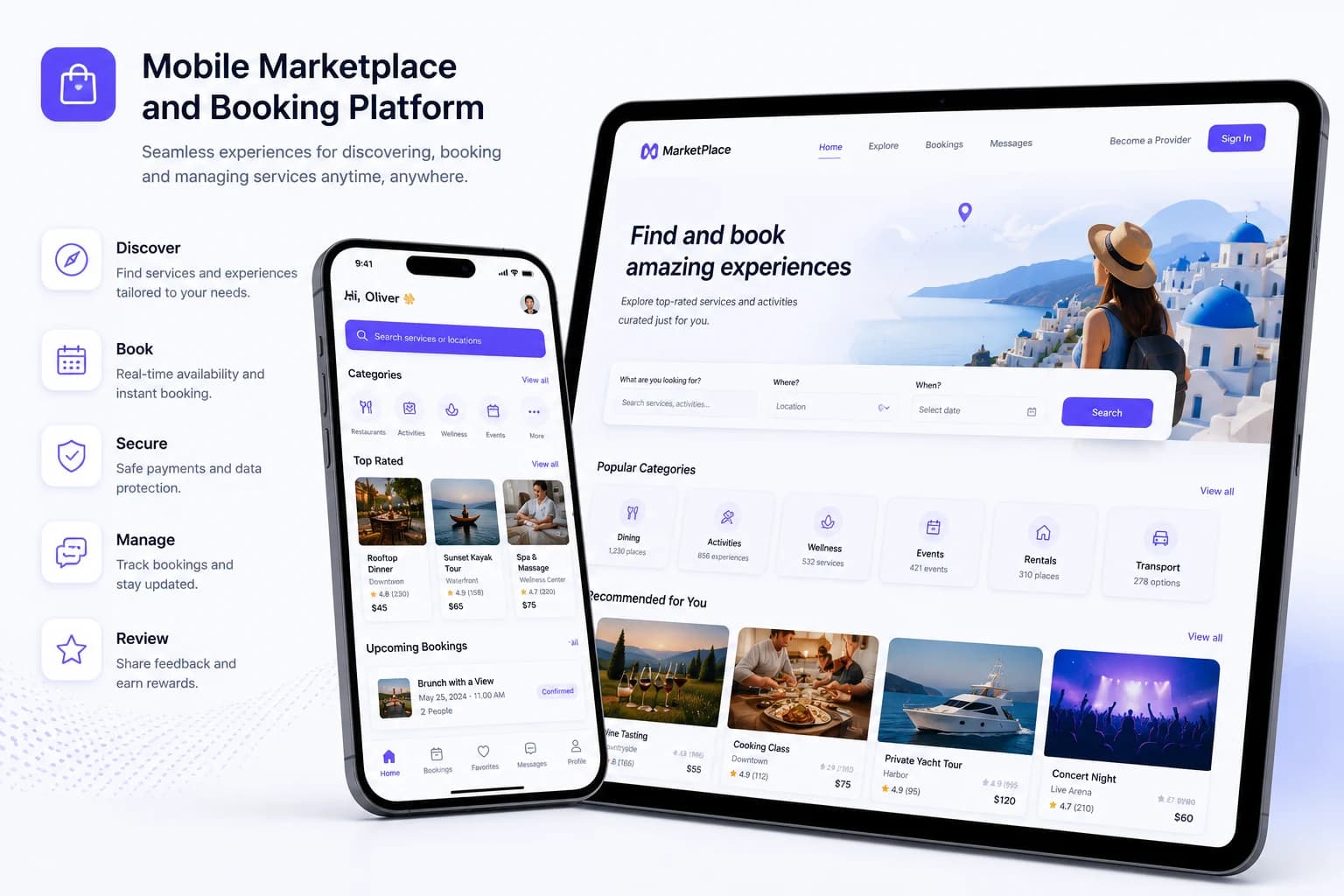
Booking Marketplace
AI Operations Platform
Enterprise CRM
Technologies we build this on
The stack pieces most relevant to a project like this one.
Next.js Development
We build enterprise-grade web applications with Next.js, combining the App Router, Server Components, and hybrid rendering to ship products that are fast, scalable, and built to grow.
Explore the stackPostgreSQL Development
We design and operate PostgreSQL databases for enterprise software — schema design, replication, and partitioning architected around the domain's actual data integrity and scale requirements, not a generic reference schema.
Explore the stackRedis Development
We architect Redis into enterprise software as more than a cache — distributed sessions, queues, pub/sub, and rate limiting designed around the actual concurrency and data-loss tolerance a system needs.
Explore the stackServices that pair with this work
Other engineering disciplines projects like this one often need alongside it.
Custom Software Development
We design and build custom business software engineered around your operations, not adapted from off-the-shelf products.
Explore the serviceAI Development
We design and build production-ready AI systems, LLM integrations, AI agents, RAG platforms, workflow automation and intelligent business software.
Explore the serviceBusiness Automation
Automate repetitive processes, connect disconnected systems and eliminate manual work through intelligent workflows, integrations and AI-powered automation.
Explore the serviceRelated reading
Practical guides worth reading while you're scoping this kind of project.
Database Design for Enterprise Applications: A Practical Engineering Guide
Database design for enterprise applications is the discipline of structuring data models, schemas, and infrastructure so a system stays correct, fast, and maintainable as both the application and the organization grow. It covers relational and non-relational modeling, normalization and denormalization trade-offs, indexing and query performance, and the scaling patterns — partitioning, replication, caching — that keep a database healthy at real production load. Good database design is invisible when done well and expensive to fix when done poorly, which is why it deserves the same engineering rigor as any other part of the system.
Read the guideAPI-First Architecture for Enterprise Software
API-first architecture means designing and agreeing on an API's contract before writing the implementation behind it, so every client — web, mobile, partner integrations, AI systems — builds against a stable interface instead of whatever the backend happens to expose. This guide explains how that discipline is actually applied in enterprise systems, not the marketing version of the idea.
Read the guideCustom Software Development Cost in Korea
Custom software development in South Korea typically runs from the tens of millions to several hundred million KRW, and the number is driven far more by complexity, integrations, compliance, and team composition than by any single fixed price per feature — this guide breaks down exactly what shapes that number so you can scope a realistic budget before you talk to a vendor.
Read the guidePurpose-built platforms in this space
Dedicated landing pages for the specific platforms we build most often.
Restaurant Software Development Company
Restaurant management software and food ordering platforms that improve operations and customer experience.
See the solutionHospitality Software Development Company
Hospitality software that improves guest experience and automates hotel and restaurant operations.
See the solutionBuild a restaurant platform designed for modern hospitality.
Whether you're unifying reservations and ordering, automating kitchen operations, or adding AI-assisted sales forecasting, we'll help you architect it right.
No sales pressure. Just a direct technical conversation.