

Custom Software Development
We design and build custom business software engineered around your operations, not adapted from off-the-shelf products.
- Enterprise Software
- Cloud Native
- API Integrations
- Automation
- Scalable Architecture
- Estimated timeline
- Typically 3–6 months for a first production module, longer for multi-system platforms
- Platforms
- Web · Cloud · On-Premise
- Tech stack
- Next.js · Laravel · PostgreSQL · Docker
Our approach
We design and build custom business software engineered around your operations, not adapted from off-the-shelf products.
- Business-first Engineering
Every feature solves a real operational problem.
- Built Around Your Company
No unnecessary functionality inherited from generic software.
- Long-term Maintainability
Architecture designed for years of growth.
Everything under one roof
Everything included in this engagement, from architecture to long-term support — one team, one system.
Why companies choose Aixo Lab
- Business Analysis First
We map your actual operational workflow before writing a line of code, so the system fits how your business really runs, not a generic template.
- Architecture Before Development
Data model, integration points, and scaling assumptions are decided upfront — not discovered mid-build when they're expensive to fix.
- Scalable Foundation
Built to handle your business in five years, not just the version you're launching with — adding a module later doesn't mean rebuilding the core.
- Long-term Partnership
We design for the team that maintains this system after us, including your own — documentation and clean architecture are part of the deliverable.
The kind of systems we build
A handful of concrete examples — every engagement is scoped around your own operation, not a template.
Internal ERP
Customer Portal

Manufacturing Platform

Healthcare Platform

Education Platform

Marketplace Backoffice
Built on a modern, production-grade stack
Every technology here is a deliberate choice, not a default.
How we work
The same disciplined process behind every engagement, from the first architecture decision to launch.
- 01Discovery

Understand the business problem and its real constraints.
- Output:
- Scope and goals document
- Your involvement:
- Initial workshop
- 02Product definition

Translate the problem into concrete product requirements.
- Output:
- Feature spec and priorities
- Your involvement:
- Requirements review
- 03UX/UI design
Design user flows and interface before development starts.
- Output:
- Wireframes and design system
- Your involvement:
- Design feedback
- 04Technical architecture
Define system structure, data flow, and technology stack.
- Output:
- Architecture document
- Your involvement:
- Technical review (optional)
- 05Iterative development
Build in short cycles with visible, regular progress.
- Output:
- Regularly shipped working versions
- Your involvement:
- Sprint review participation
- 06Quality assurance

Test functionality, performance, and security before release.
- Output:
- Test results and fixes
- Your involvement:
- Acceptance sign-off
- 07Launch

Deploy to production with a rollback plan in place.
- Output:
- Product deployed to production
- Your involvement:
- Launch approval
- 08Continuous improvement
Monitor, maintain, and evolve the product after launch.
- Output:
- Maintenance and improvement roadmap
- Your involvement:
- Regular check-in meetings
Built for real operating constraints
Every industry has its own compliance, integration, and scale requirements — we design for the ones that apply to you.
- Fintech
We design secure fintech platforms, payment systems, digital banking solutions and financial software engineered for scalability, compliance and high-volume transactions.
- Healthcare
We design and build secure healthcare software, patient platforms, medical management systems and digital health applications engineered for reliability, compliance and long-term scalability.
- Logistics

We design logistics platforms, fleet management software, warehouse systems and supply chain solutions engineered for real-time operations and long-term scalability.
- Retail and eCommerce

We design and build scalable eCommerce platforms, online marketplaces, retail management systems and omnichannel commerce solutions engineered for growth and long-term success.
- Education
We design and build modern education platforms, learning management systems, student portals and AI-powered learning experiences engineered for scalability and engagement.
See it in practice
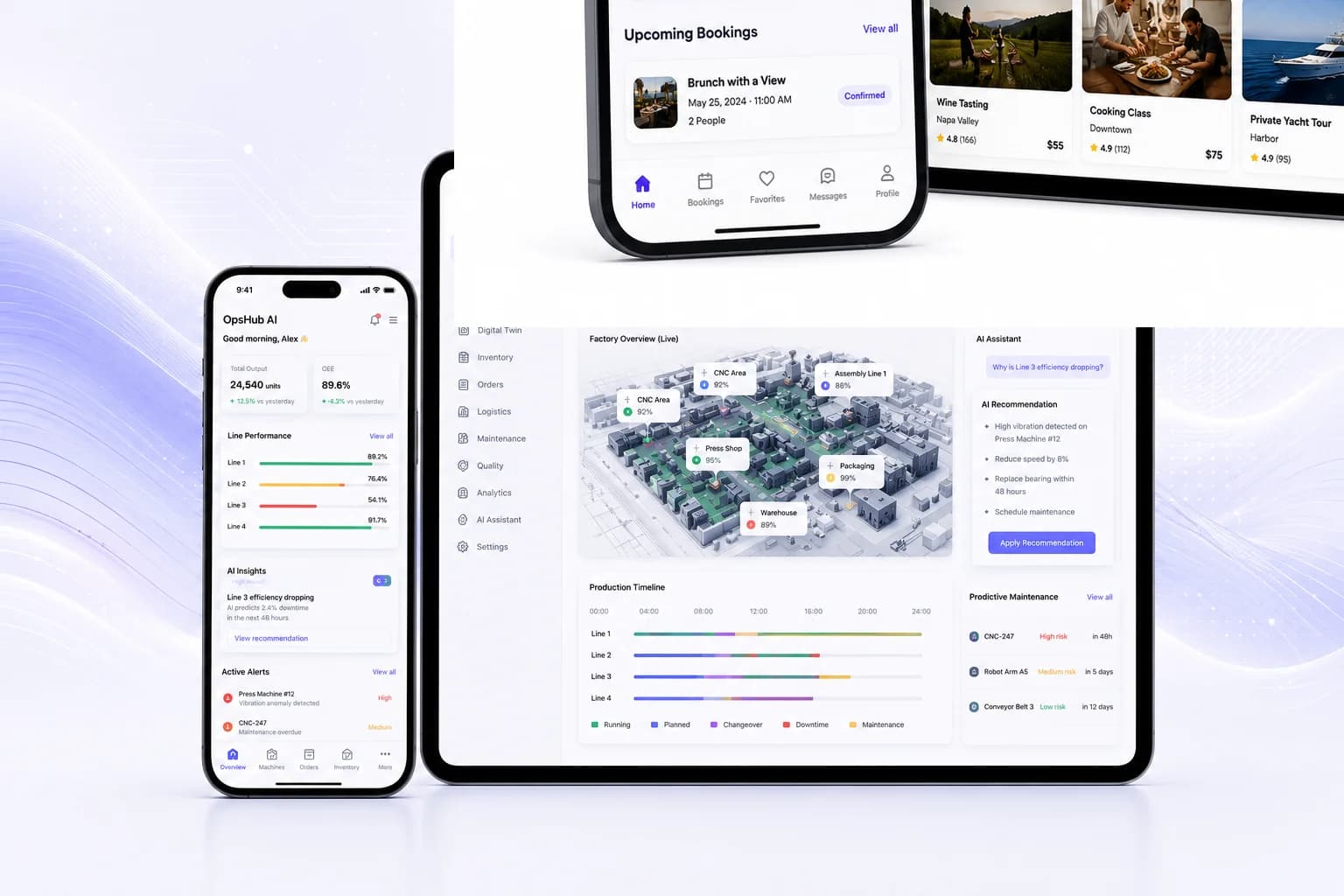
Enterprise Operations Platform
A unified operations platform integrating production, inventory, maintenance, quality control, and executive dashboards into one scalable application for a manufacturing company.
A manufacturing company managed production, inventory, maintenance, and reporting across multiple disconnected systems, with no single source of truth and constant manual reconciliation between departments.
We designed a unified operations platform integrating production, inventory, maintenance, quality control, and executive dashboards into one scalable application, replacing the disconnected systems with a single source of truth.
60% faster operations
80% fewer manual tasks
Complete operational visibility
- Next.js
- Laravel
- PostgreSQL
- Redis
- Docker
- AWS
Frequently asked questions
Related reading
Practical guides worth reading while you're scoping this kind of project.
Custom Software Development Cost in Korea
Custom software development in South Korea typically runs from the tens of millions to several hundred million KRW, and the number is driven far more by complexity, integrations, compliance, and team composition than by any single fixed price per feature — this guide breaks down exactly what shapes that number so you can scope a realistic budget before you talk to a vendor.
Read the guideModernising Legacy Systems
A practical approach to phased migration that keeps the business running throughout.
Database Design for Enterprise Applications: A Practical Engineering Guide
Database design for enterprise applications is the discipline of structuring data models, schemas, and infrastructure so a system stays correct, fast, and maintainable as both the application and the organization grow. It covers relational and non-relational modeling, normalization and denormalization trade-offs, indexing and query performance, and the scaling patterns — partitioning, replication, caching — that keep a database healthy at real production load. Good database design is invisible when done well and expensive to fix when done poorly, which is why it deserves the same engineering rigor as any other part of the system.
Read the guideAPI-First Architecture for Enterprise Software
API-first architecture means designing and agreeing on an API's contract before writing the implementation behind it, so every client — web, mobile, partner integrations, AI systems — builds against a stable interface instead of whatever the backend happens to expose. This guide explains how that discipline is actually applied in enterprise systems, not the marketing version of the idea.
Read the guideTechnologies we build this on
The stack pieces most relevant to a project like this one.
Node.js Development
We build enterprise backend systems with Node.js — REST APIs, real-time applications, and event-driven microservices architected for concurrency, scalability, and high availability.
Explore the stackPostgreSQL Development
We design and operate PostgreSQL databases for enterprise software — schema design, replication, and partitioning architected around the domain's actual data integrity and scale requirements, not a generic reference schema.
Explore the stackDocker Development
We containerize enterprise software with Docker as a deliberate engineering discipline — image builds, networking, volumes, and secrets designed for a specific production environment, not a development convenience left unchanged at deploy time.
Explore the stackServices that pair with this work
Other engineering disciplines projects like this one often need alongside it.
SaaS Development
We build scalable SaaS platforms designed for recurring revenue, multi-tenant architecture, subscriptions and long-term product evolution.
Explore the serviceWeb Development
We build fast, scalable and SEO-ready web applications, business platforms and corporate websites engineered for long-term growth.
Explore the serviceBusiness Automation
Automate repetitive processes, connect disconnected systems and eliminate manual work through intelligent workflows, integrations and AI-powered automation.
Explore the serviceWhat this looks like once built
Reference architectures from our Representative Solutions collection that plausibly apply here.
Purpose-built platforms in this space
Dedicated landing pages for the specific platforms we build most often.
Custom Software Development Company
Enterprise systems, CRMs, ERPs, and internal tools tailored to how your operation actually runs.
See the solutionCustom ERP Software Development Company
Custom ERP platforms that centralise operations and connect every department on one scalable system.
See the solutionFor CTOs and technical leadership
Executive-level engagements for organisations planning at a larger scale.
Software Architecture Consulting Services
Scalable, secure, and maintainable software architecture designed to support long-term business growth.
Explore the programLegacy Software Modernization Consulting
A structured engineering approach to modernising legacy software while cutting migration risk.
Explore the programReady to start your project?
Tell us what you're building — we'll tell you honestly whether we're the right fit.
No sales pressure. Just a direct technical conversation.